Real New York Buildings in Deadlock, Explained
Deadlock’s map is a moody, industrial-fantasy remix of New York City, and sharp-eyed players have spent a lot of time arguing that several of its monuments were lifted straight from real Manhattan landmarks. Two churches come up again and again in community discussions: St. Paul’s Chapel and Grace Church. This guide breaks down what those buildings actually are, the real-world details behind them, and how to tell the two apart when you are hunting landmarks on the map.
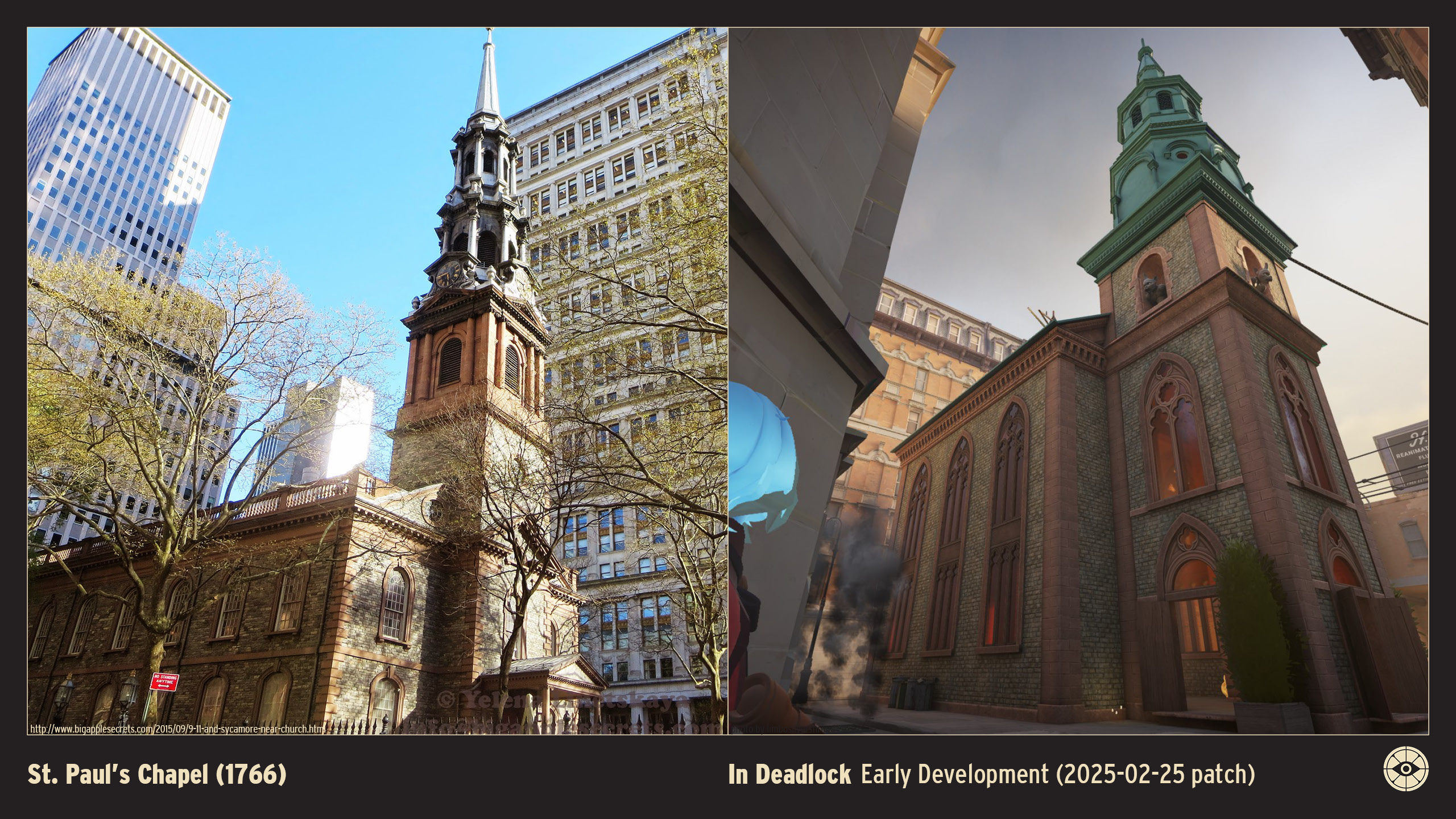
Note: The link between these landmarks and Deadlock’s world is community-reported and has not been officially confirmed by Valve. Treat the in-game associations as fan observations rather than official canon, and enjoy the real history behind them either way.
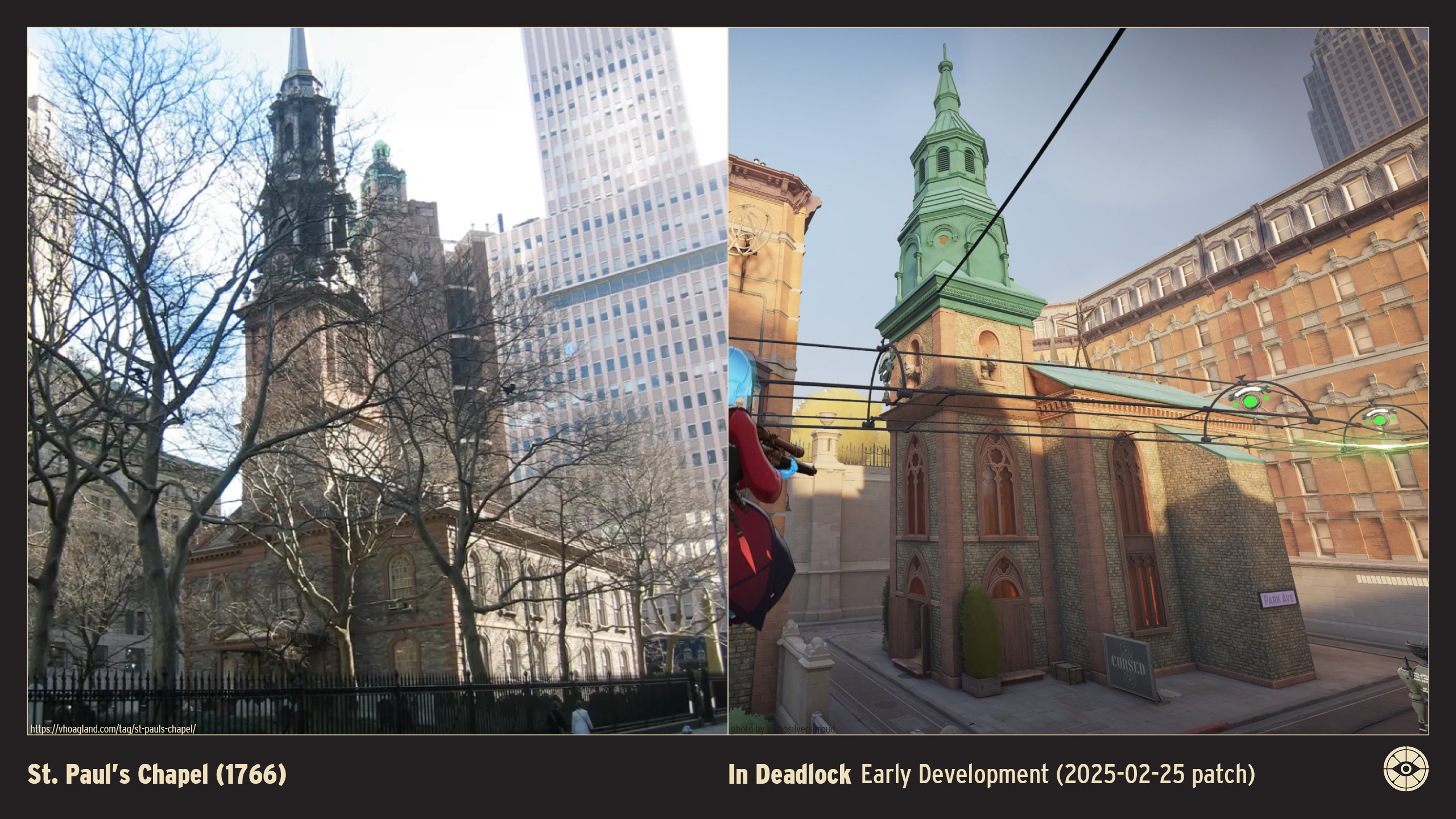
Why New York Architecture Fits Deadlock
Deadlock leans heavily on a dense, old-industrial city aesthetic, and that makes real Manhattan architecture an easy fit. The two churches below are textbook examples of how different New York’s historic religious buildings can look depending on the era: one is a restrained, symmetrical Georgian design in local stone, the other a soaring Gothic Revival spire in bright white marble. Recognizing the differences between those two styles is the fastest way to identify which landmark you are looking at.
St. Paul’s Chapel (1766) — The Georgian Survivor
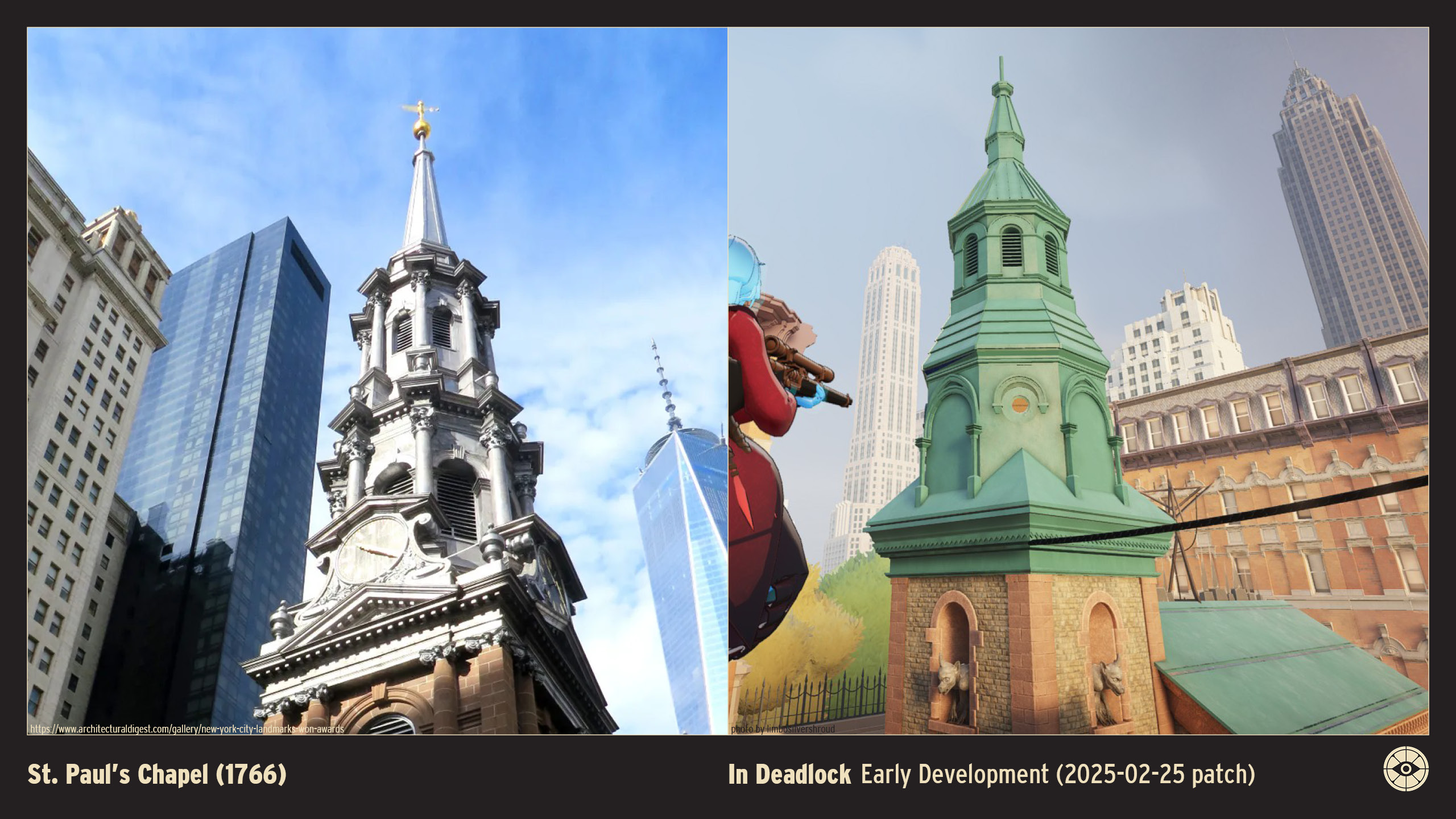
St. Paul’s Chapel, completed in 1766, is the oldest surviving church building in Manhattan and a landmark example of Georgian architecture.
| Attribute | Detail |
|---|---|
| Opened | 1766 |
| Height | 214 ft / 65 m (including spire) |
| Floors | 2 (main sanctuary and gallery) |
| Location | 209 Broadway (between Fulton and Vesey Streets), New York, USA |
| Original owner | Parish of Trinity Church (Church of England) |
| Architect | Thomas McBean |
| Style | Georgian |
| Status | Extant |
What to look for
- Symmetrical façade built from Manhattan schist, a local stone, trimmed with brownstone for a refined, elegant finish.
- A central tower that rises into a spire topped with a weather vane.
- Large arched windows fitted with wooden muntins that flood the interior with natural light.
- Inside, a barrel-vaulted ceiling and intricate wooden carvings.
The history behind it
St. Paul’s Chapel is famous for serving as a place of worship for George Washington after his inauguration, and later as a refuge for rescue workers in the aftermath of 9/11. That blend of colonial elegance and modern resilience is exactly the kind of weight a game world would borrow for a landmark.
Grace Church (1847) — The Gothic Revival Spire
Grace Church is one of the city’s most elegant Gothic Revival treasures and a National Historic Landmark.
| Attribute | Detail |
|---|---|
| Opened | 1846 (often dated to 1847) |
| Height | 230 ft / 70 m |
| Location | 800-804 Broadway, New York, USA |
| Original owner | Protestant Episcopal Church (The Rector, Church Wardens, and Vestrymen of Grace Church) |
| Architect | James Renwick Jr. |
| Style | Gothic Revival |
| Status | Extant |
What to look for
- A façade built from white Sing Sing marble, giving the church a luminous, delicate appearance compared with the darker stones typical of its era.
- A slender, lace-like spire that acts as a visual focal point when looking up Broadway.
The contrast between Grace Church and St. Paul’s Chapel is the whole story: same city, same broad purpose, completely different personality.
How to Tell the Two Landmarks Apart
If you spot a historic church on the map and want to know which one inspired it, run through these quick checks:
- Check the color and material. Dark, mixed-stone masonry with brownstone trim points to St. Paul’s Chapel (Manhattan schist). Bright, uniform white marble points to Grace Church (Sing Sing marble).
- Look at the spire. Grace Church has a famously slender, lace-like spire; St. Paul’s central tower is stockier and topped with a weather vane.
- Judge the overall style. A balanced, symmetrical, understated façade is Georgian (St. Paul’s). Ornate, pointed, upward-reaching detail is Gothic Revival (Grace Church).
- Compare the height. Grace Church is the taller of the two at 230 ft / 70 m, versus 214 ft / 65 m for St. Paul’s.
What’s Real vs. What’s Game Fiction
Because this is community-reported information, it helps to keep track of what is verifiable history and what is fan interpretation.
- Real and documented: Every attribute in the tables above — dates, heights, locations, architects, owners, and styles — describes the actual New York buildings.
- Community-reported, not official: The idea that these landmarks are referenced or recreated in Deadlock’s map. Valve has not confirmed any direct connection, so treat the in-game match-ups as observations rather than fact.
Quick Answers
Are St. Paul’s Chapel and Grace Church real buildings? Yes. Both are real, still-standing New York City landmarks — St. Paul’s Chapel dates to 1766 and Grace Church to the 1840s.
Are they officially confirmed to be in Deadlock? No. Their appearance or inspiration in Deadlock is community-reported and has not been officially confirmed.
What style is St. Paul’s Chapel? Georgian, designed by Thomas McBean.
What style is Grace Church? Gothic Revival, designed by James Renwick Jr.
Which one is taller? Grace Church, at 230 ft / 70 m, versus St. Paul’s Chapel at 214 ft / 65 m.